
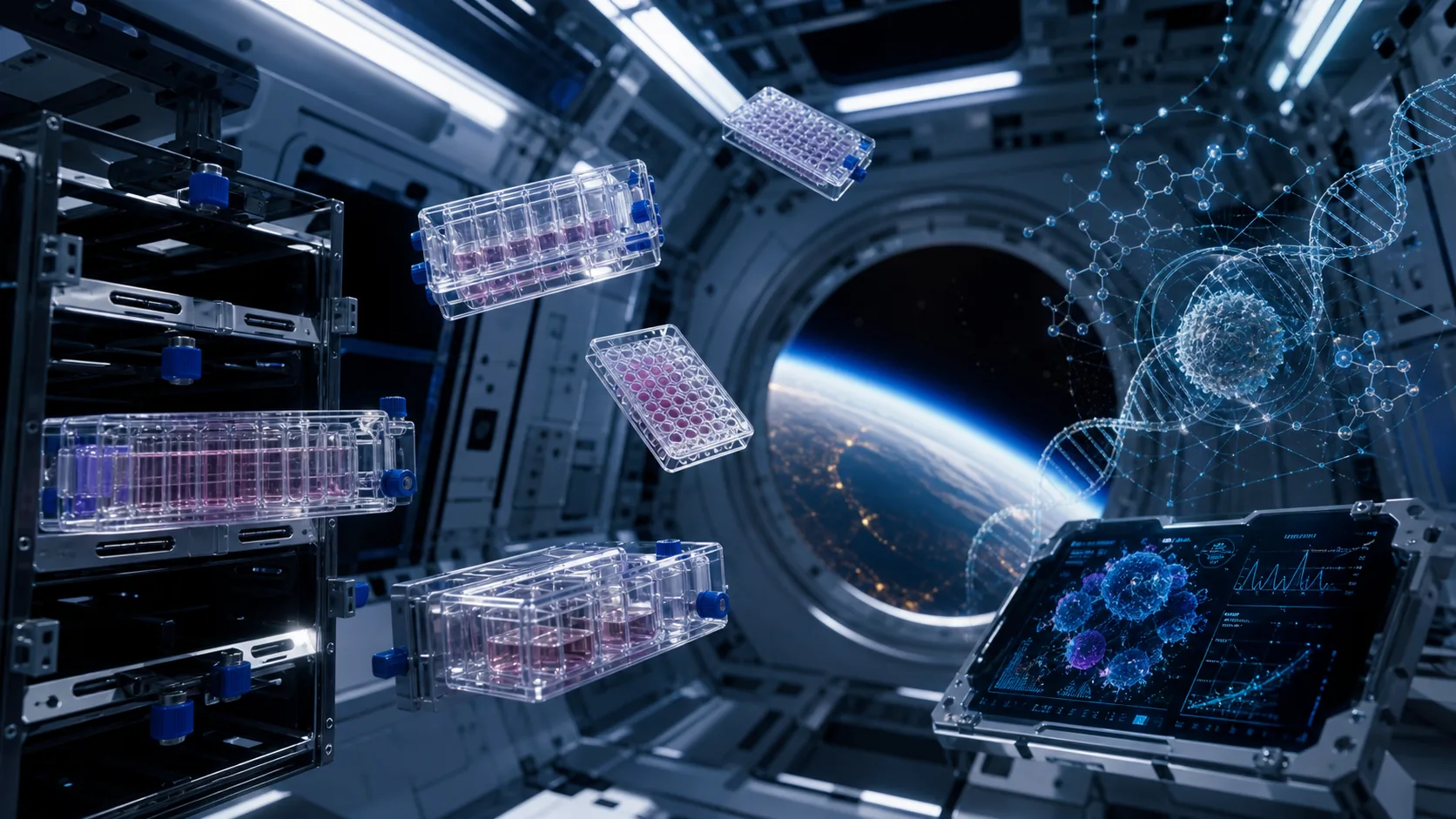
Why Microgravity Enters Drug R&D
Microgravity drug development sounds futuristic, but its core questions are familiar: how do drug substances nucleate, crystallize, aggregate, sediment, diffuse, stabilize, and release; and how do cells change morphology, metabolism, and signaling when mechanical forces and gravity vectors shift? Earth experiments assume gravity. Microgravity temporarily removes that default condition.
Varda’s public materials state the physical logic directly: microgravity suppresses convective currents, buoyancy, and sedimentation, and crystals can become more uniform in size and structure. For pharmaceutics, this is not magic; it is physical chemistry. Solid form, particle-size distribution, dissolution, stability, manufacturability, and IP can all be influenced by nucleation and growth.
From Protein Crystals to Small-Molecule Forms
Protein crystal growth is one of the historical anchors of space-based pharmaceutical research. By reducing sedimentation and convection, microgravity may enable larger, more ordered, lower-defect crystals for structural analysis. Clearer structures can reveal binding sites, conformational changes, and molecular interactions relevant to rational drug design.
More recently, small-molecule crystallization and formulation have become central. Varda has highlighted ritonavir- and nirmatrelvir-related studies, as well as research using gravity as a variable for particle-size distribution and polymorph relationships. Solid form is not a packaging detail. Different forms can change solubility, stability, hygroscopicity, tableting behavior, and bioavailability.

Formulation Is A Natural Use Case
Formulation development is often less visible than target discovery, but for patients it determines storage, dosing, infusion burden, and adherence. Varda’s biopharma materials frame microgravity as a path for small-molecule and biologic formulation, with possible goals including shelf-life, bioavailability, and patient experience.
That means microgravity R&D is not limited to new molecular entities. It may also support life-cycle management of marketed drugs or process IP for new chemical entities. If a drug is difficult to crystallize, formulate, or deliver on Earth, microgravity can serve as a screening axis for new solid forms or process windows. The hard requirement is proving that useful properties survive return and can be understood on the ground.
From Space Experiment to Pharma Workflow
A mature workflow is not simply ‘send it to space.’ It begins with terrestrial crystallization and formulation screening, then uses hypergravity or simulated microgravity to test gravity sensitivity. Only when the signal is strong should a project move to orbital testing. Returned samples then require solid-state, thermal, spectroscopic, microscopic, dissolution, and chromatographic characterization.
Varda’s public funnel follows that logic: terrestrial process development, hypergravity, microgravity, and post-flight characterization. The key word is de-risking. Orbital resources are expensive. Ground-based gravity screening and process modeling help identify which compounds or processes are actually sensitive enough to justify flight.
Microgravity Biology
Microgravity affects biological systems as well as drug substances. NASA’s Biological & Physical Sciences program emphasizes microgravity and radiation as space stressors that can reveal biological and physical phenomena. Cytoskeleton, cell polarity, immune response, DNA damage, proteostasis, mitochondrial metabolism, and inflammatory signaling may all respond to altered gravity.
For drug development, that matters in two ways. First, microgravity can pressure-test disease mechanisms. If a pathway amplifies, reverses, or reorganizes under microgravity, it may be closely tied to mechanical force or environmental adaptation. Second, it offers a second axis for translation: if a candidate remains directionally consistent across species and environmental perturbation, its mechanism may be more robust.
Do Not Mythologize Microgravity
The field is easily misread as ‘drugs made in space are automatically better.’ That is not science. Microgravity changes conditions, but it also introduces confounders: launch vibration, temperature control, radiation, loading, time in orbit, return thermal history, batch variation, and analysis delay. Without rigorous controls, space experiments create stories rather than decision evidence.
Microgravity drug development must therefore emphasize design discipline. Earth controls must match time, temperature, and containers. Simulated microgravity and hypergravity studies must state their limitations. Sample chain of custody must be recorded. Analytical endpoints should be defined before flight. The more exciting the platform, the more basic pharmaceutical discipline matters.
From Samples to Data Assets
The outcome should not be that a returned sample simply ‘looks different.’ The valuable asset is a relationship: gravity level versus particle-size distribution, polymorph ratio versus cooling profile, pathway activation versus exposure time, biomarker behavior versus species background. Relationships can be modeled; isolated observations cannot.
If each orbital mission produces only a polished report, it will not transform R&D. If repeated missions generate structured datasets linking molecular properties, process conditions, environmental variables, return conditions, and analytical results, the field can build a predictive framework for what should fly. The scalability of microgravity drug development depends on reusable data, not flight count alone.
Astrava’s View
Astrava’s view differs from pure space-manufacturing narratives. We care about how the environment axis serves drug translation. Many costly failures occur when models fail to migrate: animals work but humans do not, Earth stability fails in extreme environments, or a clear assay drifts in complex biology. Microgravity is an orthogonal perturbation for testing mechanism robustness.
That is where ASTRA-Tx matters. The platform must connect structure, omics, assays, PK/PD, toxicology, formulation, species, and environment data. A microgravity experiment should answer a specific question: did the candidate’s physical form change; did a disease-relevant pathway shift; did a biomarker remain directional across species; did the result alter go/no-go logic?
cGAS, HDAC6, and Environmental Perturbation
In Astrava’s biology, cGAS and HDAC6 are naturally connected to environmental stress. cGAS-STING links DNA damage, innate immunity, and inflammation. HDAC6 connects cytoskeleton, proteostasis, stress granules, and autophagy. In microgravity, cytoskeletal remodeling, DNA damage responses, immune signaling, and proteostasis changes may open new observation windows.
This does not mean microgravity directly proves a target. It helps reveal mechanism boundaries. A compound that works in a standard cell model may not remain directionally stable under altered mechanics, radiation, or prolonged stress. Environmental perturbation is not a replacement for disease models; it helps identify which mechanisms are background-dependent and which behave more like invariants.


Regulatory and Scale-Up Questions
Even if the science is strong, regulation and industrialization remain hard. Orbital production has limited batch size, high cost, and immature quality systems. If an orbital process becomes part of a marketed product, developers must prove batch consistency, impurity control, stability, scalability, and supply reliability. For most programs, the near-term path is not large-scale space manufacturing, but discovering or validating ground-replicable process windows.
That is why return-enabled discovery may be more realistic than permanent orbital manufacturing in the short term. Microgravity can reveal a form, particle behavior, or mechanism. The next step is to see whether a terrestrial process can reproduce or exploit it. Only if a critical material form cannot be made on Earth and has enough commercial value will full orbital production become a stronger proposition.
The Next Opportunities
Near-term opportunities include small-molecule solid forms and particle control, high-concentration biologic formulations, protein structural biology, tissue chips and organoids, cellular aging and immune stress models, and stability testing under extreme environments. These areas point to a common role: microgravity as a difference amplifier and mechanism stress test.
For Astrava, the opportunity belongs inside a broader funnel: ground, simulated microgravity or hypergravity, orbital experiment, and post-flight characterization. Each step exists not to prove space is superior, but to move the experiment toward maximum information. Good space pharmacology knows which projects do not need to fly, which ones must fly, and what should be measured once they do.
Conclusion
Microgravity drug development is moving from curiosity toward pharmaceutical engineering. It is no longer only a historical story about protein crystals or a commercial-space slogan. It is a field that requires physical chemistry, cell biology, pharmaceutics, space engineering, and data science to define together. Its value is not replacing Earth experiments, but adding the environmental dimension they lack.
When we say medicines should move from Earth toward Mars, we do not mean drug development must leave Earth. We mean drug development must learn to handle species differences and environment differences. Microgravity makes environment difference usable; Astrava’s job is to turn that difference into testable, reusable, decision-grade translational evidence.
Ground Simulation Is Not A Substitute
Simulated microgravity systems, rotating wall vessels, clinostats, random positioning machines, hypergravity centrifuges, and drop towers can all help researchers understand gravity-related variables. They do not fully replace true orbit. Simulation devices can also change shear, fluid motion, interfaces, sample orientation, and hardware constraints. Orbit adds real weightlessness, radiation, launch, and return. They should form a calibration system, not compete as substitutes.
That matters for drug development. If a candidate system changes only in one simulation device, researchers must ask whether the effect comes from gravity or from the device itself. If the same directional signal converges across simulation, hypergravity, and orbital samples, confidence increases. Microgravity drug development needs evidence gradients, not isolated conclusions.
Analytics Define Value
The analytical capacity for returned samples sets the ceiling for orbital experiment value. For small molecules and formulations, analyses may include XRPD, DSC, TGA, Raman, FTIR, NMR, HPLC, LC-MS, microscopy, particle-size distribution, and dissolution. For cell and tissue models, they may include transcriptomics, proteomics, immunostaining, metabolomics, morphology, and functional readouts. Without these, orbit rarely becomes pharmaceutical knowledge.
Analytical methods should ideally be registered into the experimental design before flight. Otherwise teams may choose metrics after seeing differences, creating interpretive bias. Serious space pharmacology should define primary, secondary, and exploratory endpoints the way disciplined preclinical research does. Even negative results then become useful for the next experiment.
IP and Clinical Relevance
The commercial value of microgravity drug development may sit at the intersection of intellectual property and clinical relevance. New solid forms, particle-control methods, formulation processes, or biological readouts can become assets. But they matter only if they connect to patient experience, efficacy, safety, stability, or manufacturability. A sample made in space is not automatically a business moat.
A microgravity project should ask from the beginning: how does this result change the product? Does it improve dosing, reduce dose frequency, increase stability, reduce cold-chain dependence, improve dissolution, or expand patent space? If the answer is unclear, the work may be basic research. If it is clear, orbital testing can become part of product strategy.
From Research Service to Platform Asset
The long-term value of microgravity R&D is not a single mission, but a platform asset. As more molecules, formulations, cell models, and environmental conditions are recorded, researchers can begin to build rules: which molecular features are prone to solid-form shifts in microgravity, which pathways respond to gravity loss, and which biomarkers remain stable across species and environment.
That is the direction Astrava cares about. We do not want each space experiment to start from zero. We want them to become a reusable knowledge graph. If one orbital experiment makes the next one smarter, it is already creating platform value. If it also helps ground models predict which experiments do not need to fly, its value is even greater. When microgravity matures, the most important capability may not be access, but selection.
From Preclinical Translation to Humans
Microgravity ultimately serves the same question as all drug development: can a medicine produce predictable effects in humans? It can reveal environment-sensitive mechanisms, but it cannot replace human evidence. Its better role is as an orthogonal preclinical judgment: if a candidate is directionally consistent across species and maintains key readouts under environmental perturbation, teams can have more confidence in which mechanisms deserve continued investment.
Conversely, if a mechanism becomes unstable under microgravity or related perturbations, that does not automatically mean failure. It may help teams reinterpret indication choice, dosing context, biomarkers, and patient segmentation. Microgravity does not provide simple answers. It exposes fragility earlier. For Astrava, that ability to surface uncertainty before it becomes expensive is itself a core platform value.
For Astrava, the core meaning of microgravity is not the label of space manufacturing. It is making environment a variable inside the translational model: testing which mechanisms hold across both species and environment shifts.